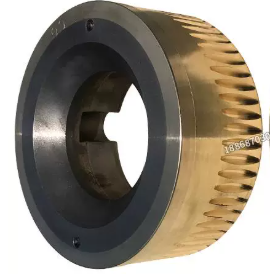
The copper worm wheel serves as the core driven component of the punch press worm and worm gear reduction mechanism. It undertakes critical functions including overall machine deceleration transmission, torque amplification, and slider lifting adjustment. Compared with steel worm gears, copper worm wheels feature superior self-lubricating performance, low friction coefficient, anti-seizing capability, excellent shock absorption and noise reduction. They are the fundamental guarantee for preventing transmission jamming, tooth surface abrasion and high-speed abnormal noise during punch press operation. Most common punch press failures on the market, such as transmission malfunction, accelerated wear, clearance enlargement, adjustment jamming, stalling and slipping, mainly stem from impure raw materials, loose casting structure, inaccurate tooth profile, insufficient finishing precision and uncontrolled pairing clearance of copper worm wheels. In foreign trade procurement, low-cost sand-cast worm wheels and impure mixed-copper worm wheels are the primary causes of after-sales returns and end-user complaints. This article systematically elaborates on the material standards, casting technology, precision machining, anti-wear quality control and failure prevention key points of punch press copper worm wheels.
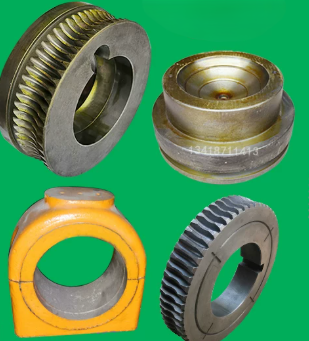
1. Core Material Standards for Copper Worm Wheels (Anti-Wear and Load-Bearing Foundation)
High-Grade Dedicated Alloy Materials :Genuine export-grade punch press worm wheels are uniformly manufactured with high-proportion tin bronze ZCuSn10Pb1 and aluminum bronze ZCuAl10Fe3. The alloy features high density and compact grain structure, delivering excellent impact resistance, wear resistance and anti-seizing performance. It fully adapts to high-frequency, heavy-load transmission working conditions of precision punch presses.
Conventional Industrial-Grade Materials: High-strength manganese brass ZCuZn38Mn2Pb2 is applied to medium and small-sized punch presses. It offers outstanding toughness, reliable self-lubrication and superior cost performance, satisfying conventional stamping load requirements. Its wear resistance and service life far outperform ordinary mixed-copper castings.
Material Prohibition and Restriction Standards: The use of recycled mixed copper and scrap copper for remelting and casting is strictly prohibited. Such materials contain excessive impurities with unstable chemical compositions and loose internal structures, which easily cause tooth breakage, edge chipping and accelerated abrasive wear. They are completely unqualified for heavy-duty continuous industrial operation.
Incoming Material Quality Control: Each batch of copper alloy materials undergoes spectral composition testing. The proportions of tin, aluminum, manganese and lead elements are strictly controlled to ensure stable alloy mechanical properties, eliminating material-induced failure risks from the source.
2. Centrifugal Casting Process Quality Control (Eliminating Internal Defects)
High-Speed Centrifugal Forming: The horizontal centrifugal casting process is adopted. Relying on high-speed centrifugal force, the molten copper is fully compacted while bubbles and scum are completely discharged. The finished worm wheel is free of pores, sand holes and inclusions, featuring a dense and uniform internal structure. Its overall load-bearing performance is far superior to that of ordinary sand-cast products.
Gradient Solidification Quality Control: Strict control over pouring temperature and gradient cooling rate realizes sequential layer solidification from outside to inside. The outer tooth surface achieves high hardness and excellent wear resistance, while the inner matrix maintains sufficient toughness and impact resistance. This dual-structure characteristic adapts to alternating working conditions of transmission friction and impact load.
Casting Stress Relief Treatment : After casting forming, low-temperature aging annealing is performed to thoroughly eliminate internal casting stress. This prevents deformation during subsequent precision machining, tooth profile deviation during operation, and abnormal transmission clearance errors.
Blank Defect Screening: Each cast blank undergoes full appearance inspection plus sampling slice inspection to eliminate hidden defects such as cracks, porosity, cold laps and shrinkage cavities. All unqualified blanks are strictly rejected to ensure consistent casting quality.
3. Core Precision Machining Technology for Worm Wheels
Unified Machining Reference: Precision machining of worm wheel blanks adopts one-time clamping and positioning with a unified machining reference. It eliminates positioning deviation caused by repeated clamping, ensuring that end face perpendicularity, outer circle roundness and inner hole coaxiality fully comply with standard requirements.
CNC Precision Gear Hobbing: Professional CNC gear hobbing equipment is adopted for tooth profile machining. Cumulative errors of tooth profile angle, tooth pitch and tooth direction are strictly controlled to achieve uniform tooth surface meshing and consistent force bearing, avoiding single-point stress concentration.
Fine Tooth Surface Modification: Smoothing modification is performed on tooth tips and tooth roots to eliminate stress concentration points. This effectively prevents tooth root cracking and tooth surface abrasion under heavy-load impact, optimizes meshing smoothness, and reduces operational abnormal noise.
Inner Hole Precision Boring and Mirror Grinding: The inner hole of the worm wheel assembly undergoes precision boring and mirror surface grinding. Fit tolerance is strictly controlled to achieve zero-clearance tight fitting with the shaft body, eliminating eccentric transmission, vibration and clearance-induced abnormal noise.
End Face Precision Milling and Leveling: Precision milling is applied to both end faces to meet standard parallelism tolerance. After assembly, the end faces achieve smooth fitting and uniform force distribution, preventing eccentric load abrasion and unilateral accelerated wear.
4. Assembly Pairing and Anti-Wear Protection Quality Control Key Points
Precise Worm and Worm Wheel Pairing: Each batch of worm gears and matching worms undergoes staged pairing and debugging. The meshing backlash and contact pattern are precisely controlled to ensure sufficient meshing area, smooth transmission, zero jamming and zero clearance play.
Lubrication Structure Precision Control: The machining accuracy of the worm wheel oil storage groove and oil guide structure is strictly guaranteed. This enables lubricating oil to uniformly cover the entire tooth surface, forming a continuous protective oil film. It effectively prevents dry friction, tooth surface burning and abrasive wear failures.
Pre-Assembly No-Load Debugging: After pre-assembly, finished products undergo extended no-load operation testing. The inspection eliminates hidden problems such as meshing abnormal noise, transmission jamming and excessive temperature rise, ensuring long-term stability of the transmission system.
Anti-Oxidation Protection Treatment: Precision-machined worm wheels are treated with professional surface anti-oxidation treatment. The process prevents copper tooth surfaces from moisture corrosion, oxidation and burr generation, and further improves tooth surface smoothness and overall wear resistance.
5. Common Failure Modes and Avoidance Solutions of Copper Worm Wheels
Accelerated Tooth Surface Wear: Rapid tooth surface wear is mainly caused by impure alloy materials, loose sand-cast structures and low tooth profile accuracy. The fundamental avoidance method is to adopt standard alloy centrifugal-cast worm wheels to ensure uniform tooth surface meshing.
Tooth Surface Erosion and Adhesion :Tooth surface erosion and adhesion generally result from insufficient lubrication, unbalanced meshing clearance and rough tooth surface finish. Strictly controlling pairing clearance and maintaining a complete standard lubricating oil film can effectively avoid such failures.
Tooth Breakage and Chipping: Tooth breakage and chipping are induced by internal casting defects, local stress concentration and insufficient material toughness. The comprehensive solution includes aging stress relief treatment, professional tooth root shaping and adoption of genuine high-quality alloy materials.
Enlarged Transmission Clearance and Precision Deviation: Excessive inner hole tolerance, unreasonable assembly clearance and unilateral tooth surface wear will lead to increased transmission clearance and operational precision deviation. Precision boring and accurate pairing processing eliminate eccentric operation fundamentally.
6. Core Guide to Avoiding Pitfalls in Foreign Trade Procurement
Strictly Avoid Sand-Cast Worm Wheels: Sand-cast worm wheels feature porous and loose internal structures with low density. Their wear-resistant service life is merely one-third of centrifugal-cast worm wheels, and they become high-failure components triggering frequent foreign trade after-sales issues.
Refuse Worm Wheels Made from Recycled Mixed Copper: Worm wheels produced with recycled mixed copper lack standardized alloy proportions, leading to unstable mechanical performance. They easily suffer sudden abrasive wear and tooth chipping, which may cause complete transmission breakdown of equipment.
Do Not Purchase Rough-Machined Worm Wheels Without Tooth Modification :Products without tooth profile modification and insufficient machining precision bring heavy meshing impact and obvious abnormal noise, accompanied by rapid wear. Such goods fail to meet the quality requirements of export-grade precision equipment.
Prioritize Complete Set Matching Procurement: Separate worm wheels and worms without staged pairing and debugging deliver non-compliant meshing backlash, which readily causes transmission failures after assembly. Procurement of matched complete sets is strongly recommended.