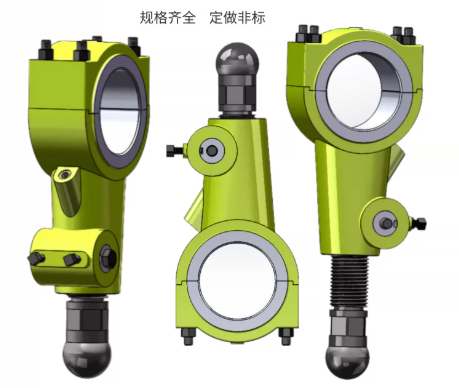
The connecting rod and ball joint serve as core force-transmitting components between the press crankshaft and slider. The stamping pressure, operational accuracy and verticality of the entire equipment are fully borne and transmitted by the connecting rod assembly. Common punch press faults, including slider tilting, stamping eccentricity, abnormal operating noise, loose connecting rods, ball joint wear and operational jamming or fracture, mainly result from substandard rod forging processes, low-precision ball joint finishing, insufficient heat treatment and uncontrolled assembly clearance. As a high-load, high-fatigue and high-safety core component of punch presses, the connecting rod and ball joint adopt far stricter production and quality control standards than ordinary mechanical parts. They are also key inspection items in factory audits and procurement reviews for major overseas clients. This article systematically elaborates on the material selection, forging technology, precision machining, assembly standards and foreign trade procurement risk avoidance key points of punch press connecting rod ball joints.
1. Quality Control of Core Raw Materials for Connecting Rods and Ball Joints
Connecting Rod Main Body Material :All connecting rods adopt forged blanks of 42CrMo alloy structural steel, with no substitution of ordinary carbon steel such as 45# steel. Featuring high strength, superior toughness, excellent fatigue resistance and impact resistance, the rods can sustain sudden stamping burst loads for long-term operation without bending, fracture or deformation.
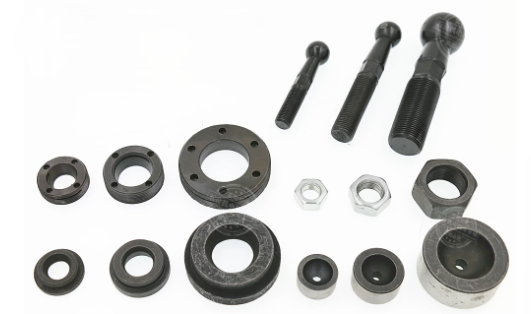
Ball Head Friction Pair Material :The ball head plunger is manufactured from hardened alloy steel with overall quenching treatment, delivering high spherical surface hardness, outstanding wear resistance and impact resistance. The ball bowl is made of high-strength tin bronze with excellent self-lubricating performance. The steel-bronze matching structure provides a low friction coefficient, prevents spherical surface damage, and effectively reduces operational noise and abrasion.
Auxiliary Accessory Material :The adjusting lead screw and lock nut are made of quenched and tempered alloy steel, offering strong shear resistance to avoid thread stripping and structural deformation. The sealing dust cover adopts anti-aging rubber material, which isolates iron filings, dust and oil contaminants and fully protects the ball head friction pair.
Raw Material Screening Standards :Each batch of incoming round steel undergoes spectral analysis and flaw detection screening. Impure steel, recycled steel and cracked blanks are strictly eliminated, fundamentally preventing fatigue fracture risks of connecting rods.
2. Precision Forging and Heat Treatment Process of Connecting Rods
Constant-Temperature Die Forging Forming :The connecting rod adopts a closed precision die forging process for one-piece integral forming. It features complete and continuous metal flow lines without cutting discontinuity or delamination. The dense overall structure delivers far higher fatigue strength than conventional free-forged products.
Forging Stress Relief Annealing: Stress relief annealing is performed immediately after high-temperature forging to thoroughly eliminate internal extrusion stress. This process prevents bending deformation, torsion and dimensional deviation during long-term loaded operation.
Overall Quenching and Tempering Heat :Treatment Connecting rod blanks undergo uniform quenching followed by high-temperature tempering. The treatment ensures consistent overall hardness and adequate toughness, balancing superior impact resistance and deformation resistance. It effectively avoids brittle fracture and plastic deformation under heavy-load conditions.
Local Strengthening Treatment :Local hardening and strengthening is applied to the hole positions and load-bearing areas at both ends of the connecting rod. It enhances local compression resistance and wear resistance, preventing hole abrasion, aperture enlargement and loose fitting clearance.
3. Precision Machining Process for Connecting Rods and Ball Heads
Unified Reference for Rough and Finish Machining :Adopting one-time clamping integral forming technology with unified machining reference eliminates positioning deviation caused by secondary clamping. It ensures high precision and consistency in the overall length, hole spacing and parallelism of connecting rods.
Precision Boring for Both-End Holes :High-precision boring is applied to the big-end and small-end holes of connecting rods. Strict control over roundness, cylindricity and coaxiality ensures tight fitting with crankshafts and pin shafts, achieving uniform force distribution during operation.
Ball Head Mirror Precision Grinding: The spherical surface of the ball head plunger is processed by CNC high-precision mirror grinding. It features consistent curvature and ultra-high surface smoothness, achieving full-surface contact with the copper ball bowl without local point contact or fitting dead angles.
Lead Screw Precision Turning: The adjusting lead screw adopts precision thread rolling technology to form standard and uniformly precise thread profiles. It enables jamming-free smooth adjustment and zero clearance after locking, realizing accurate slider height positioning and locking.
4. Standardized Assembly Process of Ball Head Assembly
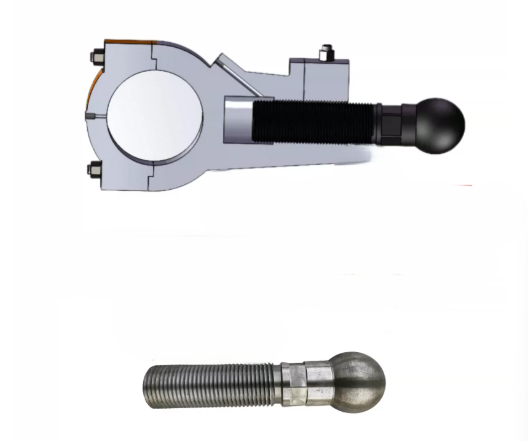
Dust-Free Assembly Environment: The ball head friction pair features precision clearance fit. The entire assembly process is completed in a dust-free environment to avoid surface scratches, operational jamming, abnormal noise and abrasive wear caused by residual iron filings and impurities.
Precise Clearance Matching: Graded matching is carried out according to the actual measured dimensions of ball heads and ball bowls with strictly controlled assembly clearance. An undersized clearance easily causes seizing and overheating; an oversized clearance leads to shaking, abnormal noise and stamping accuracy deviation.
Special Grease Filling Process :High-temperature and high-pressure resistant special grease is fully filled to cover the entire spherical friction area during assembly. It ensures reliable self-lubrication during high-speed reciprocating movement and reduces dry friction wear.
Dust-Proof and Sealing Assembly: Standardized installation of dust-proof covers, positioning retaining rings and locking accessories fully seals the internal cavity of the ball head. It blocks external dust and contaminants, effectively extending the service life of the ball head assembly.
Pre-Debugging Swing Test: After assembly, finished products undergo full-stroke swing and lifting tests to calibrate swing smoothness and lifting uniformity. This eliminates defective phenomena such as jamming, wobbling and uneven force distribution.
5. Complete Factory Quality Inspection Standards
Full Inspection of Geometric Tolerances: Inspect the parallelism, hole coaxiality, and overall length tolerance of connecting rods to qualified assembly fit and guarantee the vertical accuracy of equipment operation.
Spherical Surface Fitting Inspection :Dye penetrant testing is adopted to verify the spherical contact area, ensuring full-surface fitting and uniform force distribution, and avoiding local accelerated wear.
Layered Hardness Sampling Inspection: Separate hardness tests are performed on the connecting rod base body and ball joint surface. This balances overall toughness and surface wear resistance, eliminating risks of brittle cracking and premature abrasion.
Non-Destructive Testing: UT ultrasonic testing is conducted on connecting rod bodies to detect internal micro cracks and forging defects, thoroughly preventing fatigue fracture risks.
Assembly Load Simulation Test: Simulate the lifting and stamping load conditions of punch presses to verify the operational stability of the connecting rod assembly. No loosening, abnormal noise or wobble is permitted during operation.
6. Key Pitfall Avoidance Points for Foreign Trade Procurement
Reject Carbon Steel Substitute: Connecting Rods Ordinary carbon steel connecting rods feature poor fatigue resistance. They are prone to bending deformation and fracture under long-term stamping operation, posing major potential safety hazards.
Guard Against Low-Quality Open-Die Forging Blanks : Open-die forged connecting rods have discontinuous metal flow lines and loose metallographic structures, resulting in low structural strength and easy deformation. They cannot adapt to high-frequency and heavy-load working conditions.
Refuse Products Without Heat Treatment and Non-Destructive Testing: Small manufacturers often omit annealing, quenching and tempering, and ultrasonic testing procedures. Although such products have ultra-low costs, they suffer from extremely high failure rates of deformation and fracture, leading to frequent after-sales problems.
Avoid Crudely Machined Ball Head Assemblies: Products with rough spherical surfaces and uncontrolled assembly clearance will cause rapid abrasion, operational wobble, abnormal noise and stamping accuracy deviation after installation, resulting in high end-customer complaint rates.