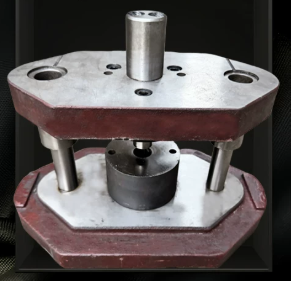
It is widely acknowledged in the industry: three parts of stamping depend on equipment and seven parts depend on molds.
A punch press is merely a power device that provides pressure. The core that truly determines the precision, shape, yield rate and production efficiency of parts is the stamping die.The same type of punch press can produce tens of thousands of hardware parts ranging from gaskets, terminals, brackets to stretched shells by changing different molds.
Following the six major stamping processes from the previous issue, this article will provide a detailed explanation of the structure, classification, and applicable scenarios of the core supporting equipment for stamping machines – stamping dies, helping you fully understand the logic of stamping production.
1. Core Structure of Stamping Dies
A set of standard stamping dies is divided into two major assemblies: the upper die and the lower die. The core components have clear functions:
1.1. Punch (Upper Die)
The core component of the upper die directly presses down the sheet metal, responsible for punching, edge cutting, and forming, and determines the inner hole and shaping dimensions of the product.
1.2. Die Cavity (Lower Die)
The core cavity of the lower die receives the punch stamping, determines the product’s external dimensions and shearing accuracy, and is the wear-resistant core part of the die.
1.3. Stripper Plate
After stamping is completed, peel off the sheet to prevent the material from getting stuck on the punch, avoiding material pulling, deformation and scratches.
1.4. Positioning GuidePins and Guide Seeves
Ensuring the precise alignment of the upper and lower dies, eliminating misalignment, burrs and dimensional deviations, is the foundation of high-precision stamping.
1.5. Mold Base and Pad
Disperse the impact force of stamping, buffer high-pressure vibration, protect the die structure and extend the overall service life.
2. The Three Mainstream Classifications of Stamping Dies (Most Commonly Used in Factories)
2.1. Single Operation Die
Also known as simple dies, a set of dies only completes one process, namely punching, blanking or bending separately.
Advantages: Low cost, simple maintenance, flexible model modification, and extremely high cost performance in small-batch production.
Disadvantages: It requires multiple manual mold changes and multiple processing procedures, resulting in relatively low efficiency.
Applicable: Sample making, small-batch orders, non-standard miscellaneous parts, simple hardware processing
2.2. Compound Die
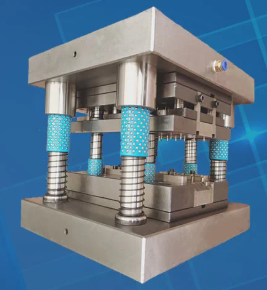
In a single stamping stroke, two or more processes are completed simultaneously. The most common one is the integrated forming of “punching + blanking”. The finished product can be formed by pressing the sheet down in one go, without the need for secondary processing.
Application: Gaskets, precision flat plates, ultra-thin hardware, high-flatness precision parts.
2.3. Continuous Die/Progressive Die
Automated mass production of top-of-the-line molds, multi-station integrated molds.
The coil material is automatically fed. Inside the mold, the processes are completed in sequence: punching → edge cutting → bending → stretching → cutting. The entire process is continuous and automated production.
Advantages: Ultra-fast mass production, extremely low reliance on manual labor, strong stability, suitable for million-level large-scale orders.
Disadvantages: High design difficulty, long production cycle, and high requirements for the stability of the punch press.
Applicable to: Mass production of 3C electronic terminals, connectors, precision auto parts, and daily-use hardware.
3. Special Function Molds
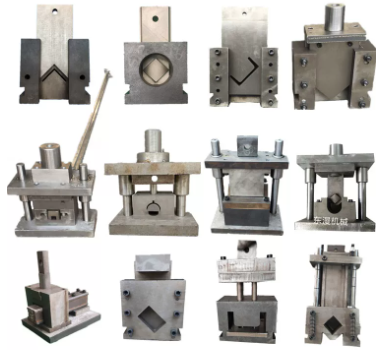
3.1. Drawing Die
Suitable for deep drawing process, specializing in the production of cup-shaped, cylindrical and box-shaped hollow shell parts, compatible with hydraulic and servo punch presses.
3.2. Shaping and Embossing Die
It is used for product leveling, embossing logos, embossing patterns, correcting forming deviations, and improving appearance accuracy.
4. The Mold Determines the Four Core Qualities of the Product
4.1. Accuracy
The fit accuracy of the guide pin and guide sleeve directly determines the tolerance of ± 0.01mm of the part.
4.2. Burrs
The gap between the die cutting edges is reasonable, and the product has no burrs and does not require secondary grinding.
4.3. Yield Rate
Precision molds have high stability, with very little deformation, chipping or scrapping.
4.4. Service Life
High-quality die steel + stress relief treatment, capable of stable stamping production for hundreds of thousands of times.
5. The Matching Logic Between Molds and Punch Presses
5.1. Simple Small Molds
Ordinary mechanical punch presses.
5.2. Composite Precision Molds
Precision mechanical punch presses/servo punch presses with high rigidity and stable accuracy.
5.3. High-Speed Continuous Die
servo CNC punching machine (must be stable, low vibration, and programmable curve).
5.4. Deep Drawing Die
hydraulic press, large-tonnage servo press.
6. summary
The press provides pressure and the die shapes the product.
Understanding the classification and adaptation logic of molds enables precise matching of equipment and mold solutions based on product structure, order volume, and precision requirements, achieving low-cost, high-yield, and high-efficiency stamping production.