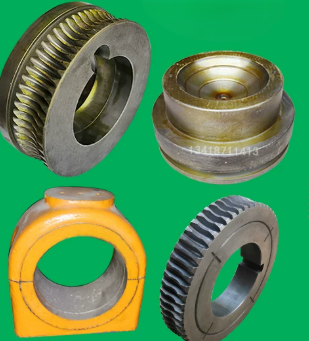
Worm gears and worms serve as the core deceleration and transmission components of mechanical punch presses. They reduce motor speed and amplify output torque, directly governing the slider stroke, stamping force, and operational stability of the equipment. Common punch press defects including abnormal noise, vibration, transmission jamming, insufficient load capacity, accelerated wear and growing clearance mainly stem from substandard raw materials, poor tooth profile machining accuracy, inadequate heat treatment hardening, and low fitting precision. As high load transmission pair accessories for punch presses, their manufacturing techniques and heat treatment quality directly determine the overall precision and service life of the entire machine, constituting the key quality verification indicators for major overseas buyers. This article comprehensively elaborates on the material selection, processing technology, heat treatment standards and core quality control criteria for foreign trade grade punch press worm gears and worms.
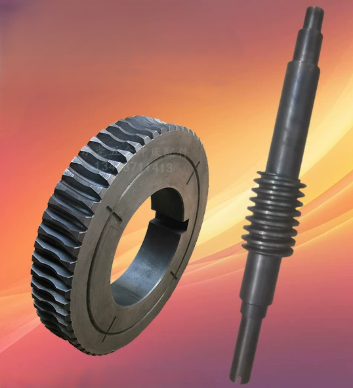
1. Core Material Selection for Worm and Worm Gear Sets (Basis for Transmission Stability)
Mainstream Materials for Worms: 40Cr and 42CrMo alloy structural steels are commonly adopted. They deliver high overall strength and favorable toughness. Following quenching and tempering plus surface high frequency quenching treatment, they exhibit excellent torsional resistance, wear resistance and impact resistance, suited for long term high frequency reduction transmission conditions.
Special Purpose Materials for Worm Gears: High strength brass and tin bronze produced via centrifugal casting are widely applied. Typical alloy grades include ZCuSn10Pb1 and ZCuZn38Mn2Pb2. They deliver outstanding self lubricating performance, low friction coefficient, anti-seizure property and wear resistance, effectively preventing tooth surface abrasion and tooth seizure induced by steel on steel hard friction.
Material Quality Control Standards: Ordinary carbon steel shall not be used as a substitute for alloy steel in worm production. Recycled mixed copper is forbidden for worm gear casting. Strict control over the uniformity of chemical composition eliminates potential risks such as tooth breakage, abrasion and transmission failure at the source.
2. Core Process Flow for Precision Machining of Worms and Worm Gears
Blank Pretreatment: Steel bar blanks undergo cutting, normalizing and stress relief treatment. Copper worm gear blanks are formed by centrifugal casting to remove internal casting and forging stress, preventing deformation in subsequent machining and operational vibration.
Rough Machining & Forming: CNC lathes perform turning to machine the overall rough contour, shaft diameter and end face, leaving machining allowance for precision finishing. This ensures consistent datums and accurate positioning for subsequent tooth profile machining.
Precision Gear Hobbing & Milling Process: Dedicated gear hobbing machines and CNC gear milling equipment are adopted for tooth profile machining. The tooth profile angle, tooth pitch and tip clearance are strictly controlled to achieve full tooth-surface meshing and even load distribution, avoiding localized single-point abrasive wear.
Tooth Surface Finishing and Grinding: Fine forming and grinding are performed on tooth flanks, tooth roots and addenda to eliminate burrs and sharp edges, preventing tooth breakage resulting from meshing seizure and stress concentration at tooth roots.
Precision Shaft Grinding: Mirror grinding is performed on the worm shaft body, bearing journals and sealing journals to ensure roundness and coaxiality tolerances conform to specifications, preventing eccentricity, abnormal noise and runout under high speed transmission.
Matching, Pre Assembly and Commissioning: Each set of worm and worm gear undergoes pre matching and pre assembly. The meshing clearance and contact pattern are adjusted to guarantee smooth transmission free of jamming and excessive backlash.
3. Key Points for Quality Control of Heat Treatment Hardening (Key to Wear Resistance and Durability)
Overall Quenching and Tempering Treatment for Worms: Combined quenching and high-temperature tempering is adopted to achieve uniform overall hardness, improve the toughness and torsional strength of the shaft body, and avoid torsion and fracture under heavy load conditions.
Tooth Surface High-Frequency Quenching Hardening: Worm gear tooth surfaces undergo high-frequency induction quenching to achieve standardized surface hardness and a uniform, wear-resistant hardened layer. Meanwhile, the tooth root retains excellent toughness, balancing superior wear resistance and fracture resistance.
Low-temperature Stress-relief Tempering: Post-quenching low-temperature tempering is performed to eliminate residual quenching stress, prevent tooth surface embrittlement and subsequent deformation, and stabilize overall mechanical properties.
Worm Gear Stabilization Treatment: Copper worm gears are subjected to low-temperature aging treatment to stabilize the metallographic structure and avoid tooth deformation and clearance drift under long-term loaded operation.
4. Full Set of Precision Quality Inspection Standards Prior to Delivery
Tooth Profile Accuracy Inspection: Specialized gear inspection equipment is used to measure deviations of tooth profile, tooth lead and tooth pitch, ensuring meshing accuracy complies with specifications and delivering smooth transmission free of impact loads.
Geometric Tolerance Inspection: The coaxiality, circular runout and end-face perpendicularity of worms are strictly controlled to eliminate transmission eccentricity and equipment vibration.
Layered Random Hardness Inspection: The surface hardness of the hardened tooth flank and the matrix toughness hardness are tested separately. This prevents brittle cracking caused by excessive hardness and accelerated wear caused by insufficient hardness.
Meshing Contact Pattern Test: Pre-assembled pairs are inspected for tooth flank contact patterns to secure adequate meshing area and even load distribution, extending the service life of components.
No-load and Load Trial Operation: No-load and loaded test runs are conducted by simulating actual punch press working conditions to eliminate hidden defects including abnormal noise, jamming and transmission lag.
5. The Gap Between High-quality and Low-quality Worm & Worm Gear Sets
Precision Disparity: Finely machined tooth profiles achieve complete meshing with consistent clearance. Rough-machined parts feature substantial tooth profile deviation and unstable clearance fluctuation, which causes obvious abnormal noise and severe vibration during operation.
Differences in Heat Treatment: Worm gears processed with standard hardening deliver wear-resistant and durable tooth surfaces, resisting burr formation and abrasion. Those without quenching treatment suffer from severe surface wear and premature failure.
Material Matching Difference: Steel worms paired with bronze worm gears offer excellent frictional compatibility. Inferior steel-on-steel combinations and worm gears made of impure copper are susceptible to tooth scoring, seizure and jamming.
Stability Difference: Premium products feature high fitting accuracy, stable transmission and minimal backlash. Inferior accessories exhibit excessive assembly clearance, leading to rapid degradation of equipment precision.
6. Foreign Trade Procurement: Key Points to Avoid Common Pitfalls
Beware of Non-quenched Worm Gears: Worm gears without high-frequency quenching feature inadequate tooth surface hardness. They suffer wear and slip in a short service period, resulting in total loss of transmission accuracy.
Reject Inferior Sand-Cast Worm Gears: Sand-cast worm gears possess loose internal structures with abundant pores and non-uniform material texture. They are susceptible to tooth breakage and deformation under heavy loads, accompanied by an extremely high after-sales failure rate.
Avoid Purchasing Unmatched Spare Parts: Spare parts without pre-matching inspection feature non-standard meshing backlash. After assembly, they are highly likely to trigger transmission jamming, abnormal noise and precision deviation.
Guard Against Material Substitution Scams: Low-cost accessories adopting carbon steel in place of alloy steel and recycled copper instead of tin bronze fail to satisfy industrial high-frequency and heavy-duty operating conditions.